








Quick Highlights
- At 4 weeks pregnant, implantation has usually happened and your body may be producing enough hCG for a home pregnancy test.
- A missed period is often the first noticeable sign, but some women have no symptoms yet.
- Mild cramping, breast tenderness, fatigue, bloating, and light spotting can occur this week.
- The developing embryo is microscopic, so there is no visible pregnancy bump and usually nothing conclusive to see on an ultrasound yet.
- Begin or continue a prenatal vitamin containing at least 400 micrograms of folic acid.
- Seek urgent medical care for severe or one-sided pain, shoulder pain, fainting, dizziness, or heavy bleeding.
At 4 weeks pregnant, you may be about to see the positive pregnancy test you have been hoping for. Your expected period may not arrive, implantation has usually taken place, and pregnancy hormone levels are beginning to rise.
You may already feel tired, bloated, crampy, or unusually emotional. You may also feel completely normal. Both experiences can happen in a healthy early pregnancy.
This week often brings a mixture of excitement and uncertainty. As a mom, I remember how quickly every tiny sensation started to feel important after seeing that first positive line. Symptoms can offer clues, but they cannot tell you how a pregnancy is progressing. Correctly timed testing and medical care are much more reliable.
4 Weeks Pregnant at a Glance
| Pregnancy milestone | What is happening |
| Gestational age | 4 weeks |
| Time since conception | Usually about 2 weeks |
| Developmental stage | Early embryo |
| Approximate size | Microscopic, around the size of a tiny seed |
| Implantation | Usually complete or close to complete |
| Pregnancy hormone | hCG is beginning to rise |
| Common milestone | Missed period or positive pregnancy test |
| Ultrasound | Usually too early for clear findings |
| Trimester | First trimester |
| Weeks until estimated due date | About 36 |
Are You Really Pregnant at 4 Weeks?
Yes, if fertilization and implantation have occurred.
Pregnancy is dated from the first day of your last menstrual period. That means you are called 4 weeks pregnant even though conception generally happened about two weeks ago. Gestational age is measured this way because the date of the last menstrual period is usually easier to identify than the exact date of fertilization.
By week 4, the fertilized egg has normally reached the uterus and attached to its lining. After implantation, cells that will help form the placenta begin producing human chorionic gonadotropin, commonly called hCG.
This hormone supports the early pregnancy and is what home pregnancy tests detect.
What Happens at 4 Weeks Pregnant?
Several important developments may happen during this week:
- The blastocyst settles into the uterine lining.
- hCG begins rising after implantation.
- Your expected menstrual period may not begin.
- A home pregnancy test may become positive.
- Cells begin organizing into layers that will eventually form the baby’s body.
- Early structures that support the pregnancy begin developing.
Even though these changes are significant, everything is still happening on a microscopic scale.
Baby Development at 4 Weeks Pregnant
Your baby is now in the earliest embryonic stage.
The implanted blastocyst contains groups of cells that will follow different developmental paths. Some will contribute to the embryo, while others will help form the placenta, amniotic sac, and other supporting structures.
The embryonic cells begin organizing into three basic layers:
- Ectoderm: eventually contributes to the brain, spinal cord, skin, and nervous system
- Mesoderm: eventually contributes to the heart, bones, muscles, blood, and connective tissues
- Endoderm: eventually contributes to structures such as the lungs, liver, and digestive system
These structures are only beginning to form. There are no recognizable facial features, arms, legs, or organs yet.
How Big Is the Baby at 4 Weeks Pregnant?
The developing embryo is microscopic.
Size estimates vary because development happens rapidly and pregnancy dates are not always exact. Food comparisons used by pregnancy apps are only visual aids, not medical measurements.
At this stage, the embryo is:
- Too small to feel
- Too small to create a baby bump
- Usually too small to be measured on a routine ultrasound
- Still developing its earliest body structures
A more meaningful milestone this week is successful implantation rather than size.
Looking for a 3 Weeks Pregnant Guide? You’re in the right place. We’ve got everything you need to know about this exciting stage of pregnancy.
Is There a Heartbeat at 4 Weeks Pregnant?
No heartbeat can normally be seen or heard at 4 weeks.
The cells that will help form the heart are beginning to develop, but the heart is not yet a fully formed organ. Cardiac activity becomes detectable later, and the exact timing depends on gestational age, equipment, ultrasound type, and individual development.
A lack of visible cardiac activity at 4 weeks is expected and does not indicate a problem.
What Does a 4 Weeks Pregnant Belly Look Like?
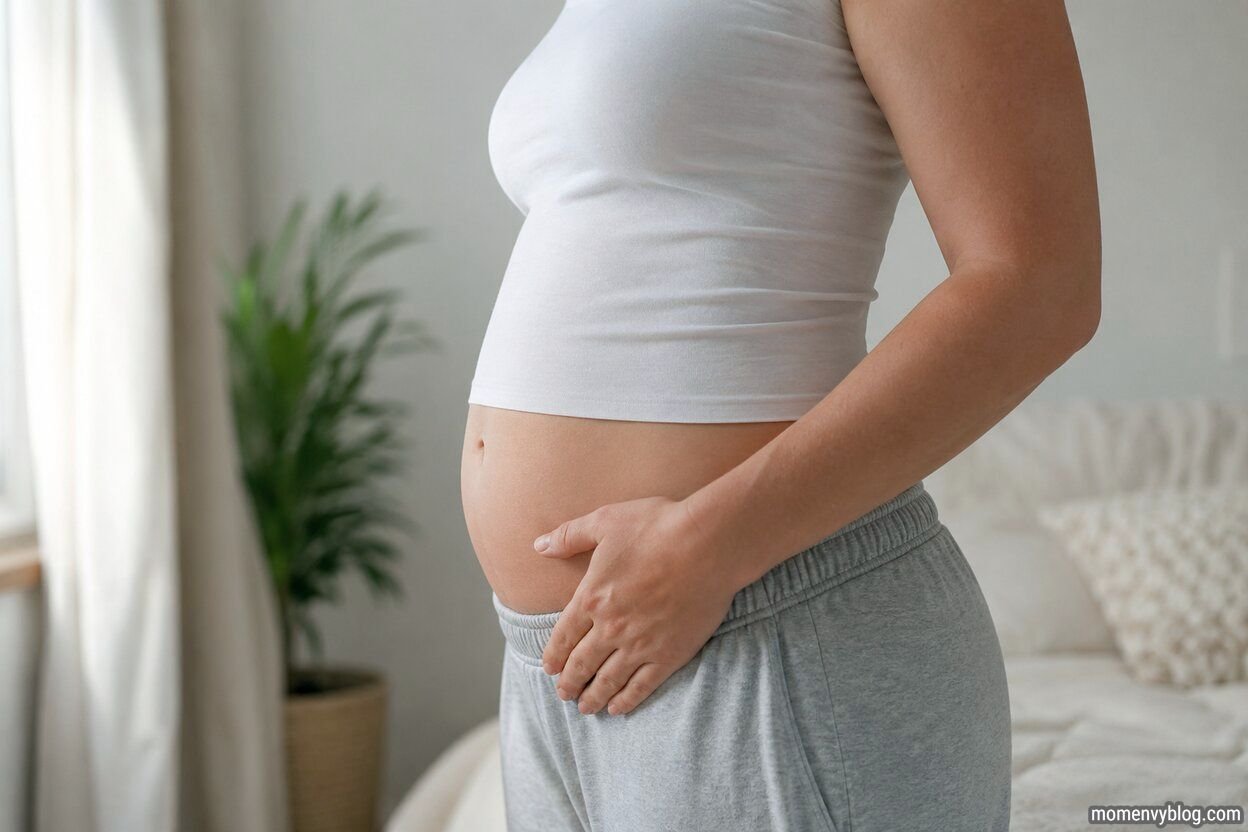
You will not have a true pregnancy bump at 4 weeks.
The embryo is microscopic, and your uterus has not grown enough to change the appearance of your abdomen. However, hormonal changes may make you feel bloated or cause your clothes to feel slightly tighter.
A 4-week belly may look:
- Completely unchanged
- Slightly bloated by the end of the day
- Fuller after meals
- Different because of constipation or gas
These changes are related to digestion and hormones, not the size of the baby.
4 Weeks Pregnant Symptoms
Every pregnancy is different. Some women notice several symptoms at 4 weeks, while others have none.
Common early signs can include a missed period, tender breasts, tiredness, nausea, more frequent urination, changes in smell or taste, and milky white vaginal discharge.
Missed period
A missed period is often the first clear sign of pregnancy.
However, a late period can also result from:
- Later-than-usual ovulation
- Stress
- Illness
- Weight changes
- Breastfeeding
- Hormonal conditions
- Changes in exercise
- Certain medications
Take a pregnancy test if your period is due or late.
Mild cramping
Mild period-like cramping can happen as the uterus responds to hormonal changes and implantation.
The cramping may:
- Come and go
- Feel like gentle pulling
- Be located low in the pelvis
- Feel similar to light menstrual cramps
Severe, worsening, or strongly one-sided pain is not something to ignore.
Light spotting
Light spotting can occur during early pregnancy. ACOG notes that spotting may happen one to two weeks after fertilization as the fertilized egg implants in the uterine lining.
Spotting may appear:
- Pink
- Light red
- Brown
- Only when wiping
- As a few drops in underwear
Bleeding alone cannot confirm implantation. Early-pregnancy bleeding can have many causes, some harmless and some requiring medical evaluation.
Breast tenderness
Your breasts may feel:
- Sore
- Heavy
- Tingly
- Swollen
- More sensitive than usual
Your nipples may also feel tender. These changes are caused by shifting hormone levels, but similar symptoms can occur before a period.
Fatigue
Feeling unusually tired is common in early pregnancy.
Hormonal changes, particularly rising progesterone, may make you feel sleepy even when you have rested. Your body is also beginning the work of supporting the pregnancy.
Rest when possible and keep meals and fluids regular.
Bloating
Pregnancy hormones can slow digestion, leading to:
- Gas
- Abdominal fullness
- Burping
- Constipation
- A tight feeling around the waist
Bloating can come and go throughout the day.
Nausea
Some women begin feeling nauseated at 4 weeks, but many do not experience morning sickness until later.
Despite its name, morning sickness can occur at any time of day. It may be triggered by an empty stomach, certain smells, heat, tiredness, or specific foods.
Heightened sense of smell
Ordinary smells may suddenly seem stronger or unpleasant.
Common triggers include:
- Coffee
- Cooking meat
- Perfume
- Cleaning products
- Smoke
- Certain toiletries
Good ventilation and cold or mild-smelling foods may help if smells make you nauseated.
Metallic taste
Some women notice a strange metallic taste in their mouths during early pregnancy. This is sometimes called dysgeusia.
It may help to:
- Sip water
- Chew sugar-free gum
- Use plastic utensils
- Eat tart foods if medically appropriate
- Brush your tongue gently
Frequent urination
You may need to urinate more often due to early hormonal and blood-flow changes.
Contact a healthcare professional if frequent urination is accompanied by:
- Burning
- Pain
- Fever
- Cloudy urine
- Blood in the urine
- Lower back pain
These may be signs of a urinary tract infection.
Increased vaginal discharge
Thin or milky white discharge can increase during pregnancy. Normal discharge should not have a strong unpleasant odor or cause significant irritation.
Seek medical advice if the discharge is:
- Green, gray, or strongly yellow
- Foul-smelling
- Accompanied by itching
- Accompanied by burning
- Accompanied by pelvic pain
Mood changes
You may feel excited one moment and anxious the next.
Hormonal changes, tiredness, and the emotional weight of a possible pregnancy can all affect your mood. Give yourself time to process the news.
Is It Normal to Have No Symptoms at 4 Weeks Pregnant?
Yes. Having no symptoms at 4 weeks can be completely normal.
Symptoms are influenced by:
- Hormone levels
- Individual sensitivity to hormonal changes
- The timing of implantation
- Whether your dates are accurate
- Previous pregnancy experience
Symptoms may start later, remain mild, come and go, or never become intense.
A lack of symptoms does not automatically mean something is wrong. In the same way, strong symptoms do not guarantee that a pregnancy is progressing normally.
Can You Get a Positive Pregnancy Test at 4 Weeks?
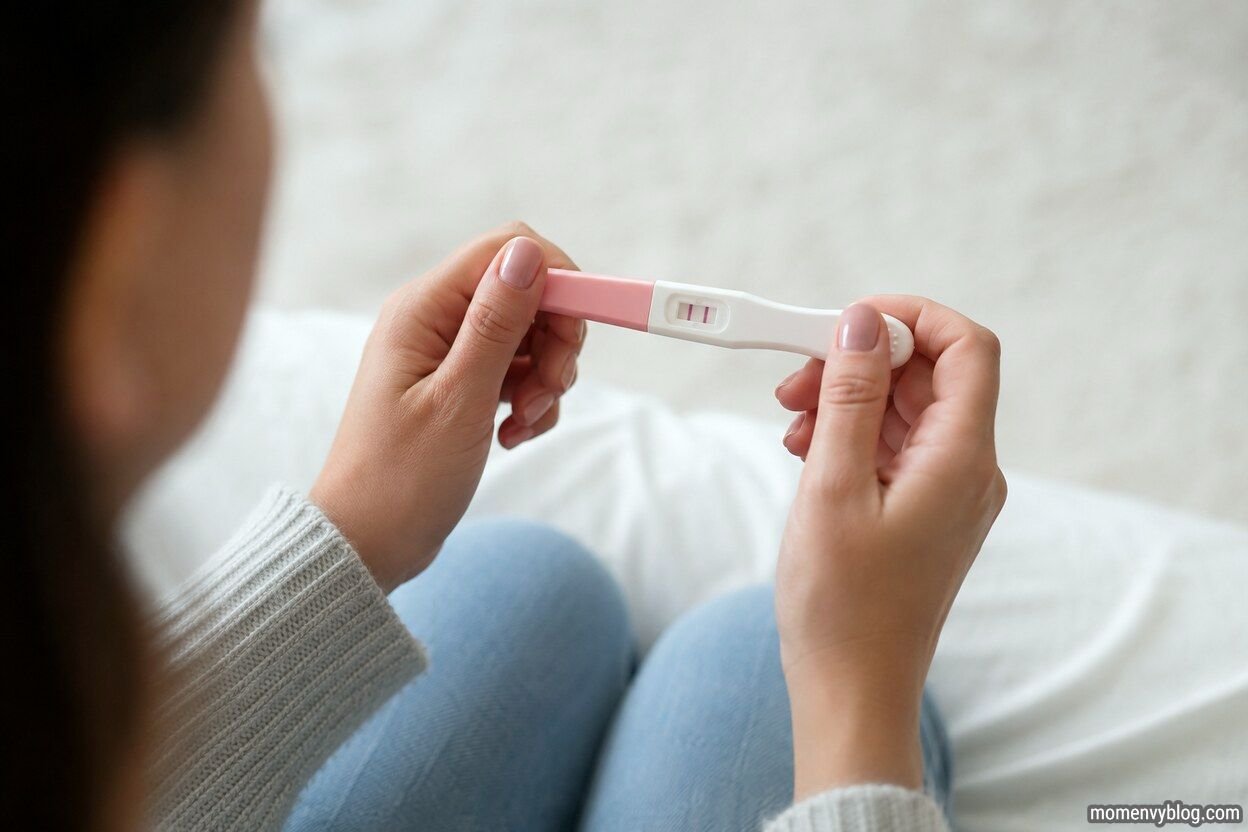
Yes. Many women can get a positive home pregnancy test around week 4, particularly on or after the day their period is expected.
Home pregnancy tests detect hCG in urine. A positive result is usually reliable when the instructions are followed correctly, while a negative result can be less reliable if the test was taken too early.
How to take a pregnancy test accurately
For the best chance of an accurate result:
- Check the test’s expiration date.
- Read all instructions before starting.
- Test on or after the day your period is expected.
- Use first-morning urine when testing very early.
- Avoid drinking large amounts of water immediately beforehand.
- Read the result only within the stated time window.
- Repeat the test if it is negative and your period still does not begin.
Different brands may have different instructions, so follow the directions included with your specific test.
What Does a Faint Positive Pregnancy Test Mean?
A faint positive line that appears within the correct reading time usually means hCG was detected.
The line may be faint because:
- You tested very early.
- Your urine was diluted.
- Implantation happened later than expected.
- Your hCG level is still low.
- The test is less sensitive.
Repeat the test in about 48 hours if you want a clearer result, or contact your healthcare provider.
Do not compare line darkness between different test brands. A home pregnancy test is designed to indicate whether hCG is detected, not to measure whether a pregnancy is healthy.
What If the Pregnancy Test Is Negative?
A negative result at 4 weeks does not always rule out pregnancy.
You may have:
- Tested too early
- Ovulated later than expected
- Used diluted urine
- Miscalculated your expected period
- Used the test incorrectly
- Used an expired or faulty test
Wait a few days and test again if your period does not start.
Contact a healthcare professional if your period remains absent and tests continue to be negative, especially if you also have pain, unusual bleeding, or a history of irregular cycles.
Can You Have a Positive Test Before a Missed Period?
Some sensitive tests may detect hCG shortly before an expected period, but early testing has a higher chance of a false-negative result.
The most reliable approach is to test on or after the day your period is expected. Testing too early can lead to unnecessary worry and repeated testing.
Should You Confirm a Home Pregnancy Test With a Doctor?

A positive home test is usually enough to contact a prenatal care provider and ask about next steps.
Your provider may not repeat the urine test if the result and dates are clear. Blood testing is not required for every healthy early pregnancy.
A clinician may order hCG blood tests when there is:
- Pain
- Bleeding
- Uncertain pregnancy dating
- A history of ectopic pregnancy
- Fertility treatment
- Repeated pregnancy loss
- Concern about how the pregnancy is developing
- A pregnancy that cannot yet be located on ultrasound
A single hCG result does not always provide enough information. When medically necessary, clinicians may look at how the level changes over time and consider symptoms and ultrasound findings together.
Can You See a Pregnancy on an Ultrasound at 4 Weeks?
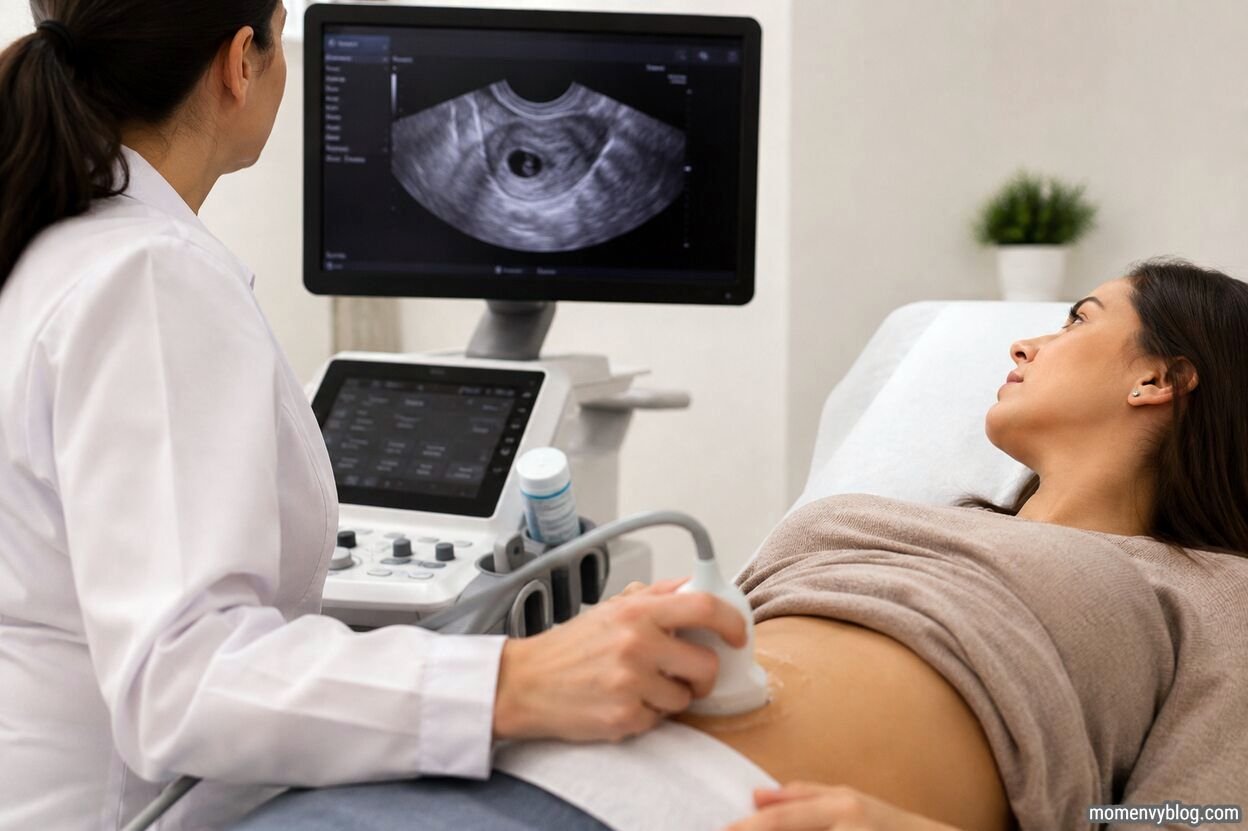
Usually, it is too early for an ultrasound to provide clear or reassuring information.
A transvaginal ultrasound may occasionally show a very small gestational sac near the end of week 4, but nothing may be visible even in a normally developing pregnancy.
At this stage, an ultrasound usually cannot reliably show:
- An embryo
- Cardiac activity
- A fetal pole
- A clear yolk sac
Having an ultrasound too early can create more uncertainty rather than reassurance. Your healthcare provider will recommend timing based on your health history, symptoms, and reason for the scan.
When Is the First Prenatal Appointment?
Contact a doctor, midwife, or maternity care provider after receiving a positive pregnancy test.
The first routine visit may be scheduled several weeks later, but timing varies by healthcare system and personal circumstances.
You may need earlier care if you:
- Have bleeding or pelvic pain
- Previously had an ectopic pregnancy
- Became pregnant through fertility treatment
- Have a long-term medical condition
- Take regular prescription medication
- Have had repeated pregnancy losses
- Are uncertain about your dates
- Have severe nausea or cannot keep fluids down
- Need support with stopping alcohol, smoking, or drugs
You do not need to wait for the first appointment to ask whether a medicine is safe.
What Should You Do at 4 Weeks Pregnant?
1.Take folic acid
Continue taking a prenatal vitamin containing at least 400 micrograms of folic acid each day, unless your healthcare provider recommends a different dose.
The CDC recommends 400 micrograms of folic acid daily for women who can become pregnant. Taking it before and during early pregnancy helps prevent neural tube defects affecting the developing brain and spine.
Some women need a higher prescribed dose because of their health history, medications, or a previous pregnancy affected by a neural tube defect. Speak with your healthcare provider rather than increasing the amount yourself.
2. Contact a prenatal care provider
Let your healthcare provider know about your positive test and ask:
- When should my first visit be?
- Should I continue my current medications?
- Which prenatal vitamin should I take?
- Do I need early blood tests?
- Which symptoms require urgent care?
- Are there changes I should make because of my health history?
Write down your questions so you do not have to remember them during the appointment.
3. Review every medicine and supplement
Check prescription medicines, over-the-counter products, herbal remedies, vitamins, creams, and supplements with a qualified healthcare professional.
Do not stop an important prescribed medication suddenly. Untreated health conditions can also affect pregnancy.
4. Avoid alcohol
The safest choice during pregnancy is not to drink alcohol.
Do not panic if you drank before knowing you were pregnant. Stop now and discuss any concerns honestly with your healthcare provider.
5. Stop smoking and avoid recreational drugs
Smoking cessation at any point during pregnancy provides benefits, with the greatest benefit seen when smoking stops early.
Ask for professional support if quitting is difficult. Treatment should be tailored to your needs.
6. Follow pregnancy food-safety guidance
Avoid foods with a higher risk of harmful bacteria, parasites, or mercury.
Depending on local guidance, this may include:
- Raw or undercooked meat
- Raw shellfish
- Raw or undercooked eggs
- Unpasteurized dairy products
- Unwashed produce
- Raw sprouts
- Refrigerated foods stored incorrectly
- Fish high in mercury
Food guidance varies by country, so use recommendations from your local health authority.
7. Eat regular, balanced meals
You do not need to eat for two.
Choose a mixture of:
- Vegetables
- Fruit
- Whole grains
- Beans and lentils
- Eggs
- Lean meat or poultry
- Low-mercury fish
- Pasteurized dairy or fortified alternatives
- Healthy fats
Small, regular meals can help if you feel nauseated or lightheaded.
8. Pay attention to caffeine
Caffeine can come from:
- Coffee
- Tea
- Cola
- Energy drinks
- Chocolate
- Some medicines
Keep track of your total intake and follow the limit recommended by your healthcare provider or national pregnancy guidance.
9. Continue suitable physical activity
Most women with uncomplicated pregnancies can continue moderate exercise.
Good options may include:
- Walking
- Swimming
- Gentle strength training
- Stationary cycling
- Prenatal yoga
- Low-impact exercise classes
Speak with your healthcare provider if you have bleeding, significant pain, a medical condition, previous pregnancy complications, or questions about a high-intensity routine.
10. Support your mental health
It is normal to feel happy, nervous, overwhelmed, or unsure after a positive test.
Helpful first steps include:
- Talking with someone you trust
- Limiting alarming online stories
- Writing down questions
- Resting when tired
- Continuing normal routines
- Seeking professional support if anxiety affects daily life
Pregnancy does not always begin with instant happiness. Mixed feelings are valid.
What Should You Avoid at 4 Weeks Pregnant?
Avoid:
- Alcohol
- Smoking and vaping
- Recreational drugs
- Medicines or supplements that have not been reviewed
- High-dose vitamins unless prescribed
- Raw or unsafe foods
- Fish high in mercury
- Excessive heat that significantly raises core body temperature
- Harmful chemical exposures
- Crash diets
- Starting extreme exercise without guidance
You do not need to avoid normal walking, climbing stairs, bending, lifting ordinary household items, or sleeping in a particular position unless a clinician gives you specific restrictions.
Can Sex Harm the Pregnancy at 4 Weeks?
Sex does not normally harm an uncomplicated early pregnancy.
The pregnancy is developing inside the uterus and cannot be dislodged by intercourse. Mild cramping or a small amount of spotting may occasionally happen afterward because pregnancy can make the cervix more likely to bleed.
Contact your healthcare provider if you have:
- Heavy bleeding
- Severe pain
- Persistent cramping
- Fluid leakage
- Specific restrictions from fertility treatment
- Medical advice to avoid intercourse
Is Cramping Normal at 4 Weeks Pregnant?
 Mild cramping can be normal at 4 weeks.
It may feel like:
- Gentle pulling
- Light period cramps
- Brief twinges
- Mild pressure low in the pelvis
Possible causes include hormonal changes, implantation, gas, constipation, or the uterus beginning to respond to pregnancy.
Contact a healthcare professional if cramping is severe, persistent, worsening, or mainly on one side.
Is Bleeding Normal at 4 Weeks Pregnant?
Light spotting can happen in a healthy early pregnancy, but bleeding should not automatically be assumed to be implantation.
First-trimester bleeding is relatively common and may result from implantation, cervical changes, infection, early pregnancy loss, or an ectopic pregnancy.
Contact your prenatal care provider for advice about any bleeding after a positive pregnancy test.
Seek urgent care if bleeding is:
- Heavy
- Accompanied by severe pain
- Accompanied by shoulder pain
- Combined with fainting or dizziness
- Accompanied by weakness
- Associated with passing tissue
- Increasing rather than improving
Ectopic Pregnancy Warning Signs
An ectopic pregnancy occurs when a fertilized egg implants outside the main cavity of the uterus, most commonly in a fallopian tube.
At first, an ectopic pregnancy may cause ordinary pregnancy symptoms or no symptoms. Warning signs can include pelvic pain, vaginal bleeding, abdominal pain, shoulder pain, dizziness, or fainting.
Seek urgent medical care for:
- Severe abdominal or pelvic pain
- Strong pain on one side
- Shoulder-tip pain
- Fainting
- Severe dizziness
- Weakness
- Heavy bleeding
- Pain with rectal pressure
An ectopic pregnancy can become a medical emergency. Do not wait for a routine appointment if you have these symptoms.
What Are the Signs of Early Pregnancy Loss?
Bleeding and cramping can occur in both healthy and nonviable pregnancies, so symptoms alone cannot confirm a miscarriage.
Possible signs include:
- Vaginal spotting or bleeding
- Increasing cramps
- Lower back pain
- Passing fluid
- Passing tissue
ACOG advises contacting an obstetric care provider about spotting, bleeding, a gush of fluid, or tissue passing from the vagina.
A sudden decrease in pregnancy symptoms does not prove that a loss has occurred. Symptoms naturally fluctuate, especially this early.
Does a Chemical Pregnancy Happen at 4 Weeks?
A chemical pregnancy is a very early pregnancy loss that happens shortly after implantation, often before anything can be seen on an ultrasound.
A person may:
- Have a faint positive test
- Later receive a negative test
- Experience bleeding near or after the expected period
- Have stronger-than-usual cramps
- Never know pregnancy occurred without early testing
Only a healthcare professional can interpret test results and symptoms in your specific situation. Early pregnancy loss is not caused by ordinary activity, exercise, sex, working, or something you thought or felt.
Can You Be 4 Weeks Pregnant With Twins?

Yes, a twin pregnancy may already be developing, but symptoms and home tests cannot confirm it.
A darker pregnancy test or stronger symptoms do not reliably mean twins. Multiple pregnancy is confirmed later using ultrasound.
At 4 weeks, it may be too early to identify the number of developing embryos.
Can You Calculate Your Due Date at 4 Weeks?
Yes. Your estimated due date is commonly calculated as 40 weeks from the first day of your last menstrual period.
A simple calculation is:
- Start with the first day of your last period.
- Add seven days.
- Subtract three months.
- Add one year when needed.
This provides an estimate. Your healthcare provider may adjust your due date based on an early ultrasound, especially if your cycles are irregular or your last menstrual period is uncertain.
4 Weeks Pregnant Checklist
Take or repeat a home pregnancy test if your period is due.
Record the first day of your last menstrual period.
Contact a prenatal care provider after a positive result.
Take a prenatal vitamin with at least 400 micrograms of folic acid.
Review medicines and supplements with a healthcare professional.
Avoid alcohol, smoking, vaping, and recreational drugs.
Follow pregnancy food-safety recommendations.
Keep caffeine within the recommended limit.
Continue appropriate physical activity.
Learn the warning signs that require urgent care.
Write down questions for your first prenatal visit.
Read the 5 Weeks Pregnant guide next.
What Happens at 5 Weeks Pregnant?
At 5 weeks pregnant, hCG levels continue rising and early pregnancy symptoms may become more noticeable.
The embryo’s foundational structures continue developing, including the neural tube, which will contribute to the brain and spinal cord. This is one reason folic acid is especially important during very early pregnancy.
Next week, you may notice:
- More fatigue
- Increasing breast tenderness
- Nausea
- Food aversions
- A stronger sense of smell
- More frequent urination
- Mild cramping
- No symptoms at all
Next article: 5 Weeks Pregnant: Symptoms, Baby Development, and What to Expect
FAQ’s
Is 4 weeks pregnant too early to know?
Not always. Many home pregnancy tests can detect pregnancy around the time your period is expected. A negative result may occur if you tested early or ovulated later than expected.
What is happening at 4 weeks pregnant?
Implantation has usually occurred, hCG is rising, and the early embryo is beginning to organize into layers that will eventually form the body and supporting structures.
What symptoms should I have at 4 weeks pregnant?
You may have a missed period, breast tenderness, mild cramping, fatigue, bloating, light spotting, frequent urination, or changes in smell and taste. You may also have no symptoms.
Is it normal to feel nothing at 4 weeks pregnant?
Yes. Many healthy pregnancies cause few or no noticeable symptoms at 4 weeks.
Can morning sickness start at 4 weeks?
Yes, but it is still early. Some women develop nausea this week, while many notice it several weeks later.
Can I get a positive pregnancy test at 4 weeks?
Yes. A test is more likely to be accurate on or after the day your period is expected. A positive result is generally reliable when the instructions are followed correctly.
Why is my test negative at 4 weeks pregnant?
You may have tested too early, ovulated late, used diluted urine, or miscalculated your dates. Repeat the test in a few days if your period does not begin.
Can you see the baby at 4 weeks?
Usually not. The embryo is microscopic, and an ultrasound may show nothing or only a very early gestational sac.
Is there a heartbeat at 4 weeks?
No heartbeat is normally detectable at 4 weeks. The structures that will form the heart are only beginning to develop.
How big is the baby at 4 weeks?
The embryo is microscopic. Exact size estimates vary and are less useful than understanding the developmental changes occurring this week.
Is spotting normal at 4 weeks?
Light spotting can occur, but bleeding has several possible causes. Contact your healthcare provider about bleeding after a positive pregnancy test.
Are cramps normal at 4 weeks?
Mild, brief cramps can be normal. Severe, worsening, or one-sided pain should be medically assessed.
Can I have a baby bump at 4 weeks?
No. Any abdominal fullness is likely caused by bloating, gas, constipation, or normal body shape.
Can I exercise at 4 weeks pregnant?
Most women with uncomplicated pregnancies can continue moderate activity. Ask your healthcare provider about restrictions based on your health and pregnancy history.
When should I make my first prenatal appointment?
Contact a prenatal care provider after your positive test. They will tell you when to attend based on their routine and your medical history.
Should I take folic acid at 4 weeks?
Yes. Most women should get at least 400 micrograms of folic acid daily unless a healthcare provider recommends another dose.
How many months is 4 weeks pregnant?
Four weeks pregnant is generally considered the end of the first month and part of the first trimester.
Can symptoms come and go at 4 weeks?
Yes. Early symptoms may change from day to day as hormone levels fluctuate. Symptoms alone cannot determine whether a pregnancy is progressing normally.
The Bottom Line
At 4 weeks pregnant, implantation has usually occurred and your body is beginning to produce more hCG. Your expected period may not arrive, and a home pregnancy test may finally show a positive result.
You might notice mild cramps, spotting, fatigue, tender breasts, bloating, nausea, or frequent urination. You may also feel no different at all.
Continue taking folic acid, contact a prenatal care provider, review your medicines, and begin following pregnancy health and food-safety guidance. Most importantly, seek prompt medical care for severe or one-sided pain, shoulder pain, fainting, dizziness, or heavy bleeding.
Medical note: This article provides general educational information and is not a substitute for personalized advice, diagnosis, or treatment from a qualified healthcare professional.


