







The Shift Toward Non-Invasive Nursery Tech
Parent expectations around nursery surveillance have evolved significantly in recent years. Where previous generations relied on basic analog audio monitors, today’s parents seek deeper, more meaningful insights into their sleeping newborns. However, placing physical wearable sensors, smart socks, or chest bands on a delicate infant often introduces friction—ranging from skin irritation and accidental displacement to unnecessary parental anxiety during nighttime adjustments. This friction has driven growing interest toward contact-free monitoring solutions. In this comprehensive baby monitor technology guide, we explore how non-invasive sensing offers visibility into infant nursery environments without requiring any direct physical contact with the child.
Principles of Contact-Free Sensing: Optics and Radar
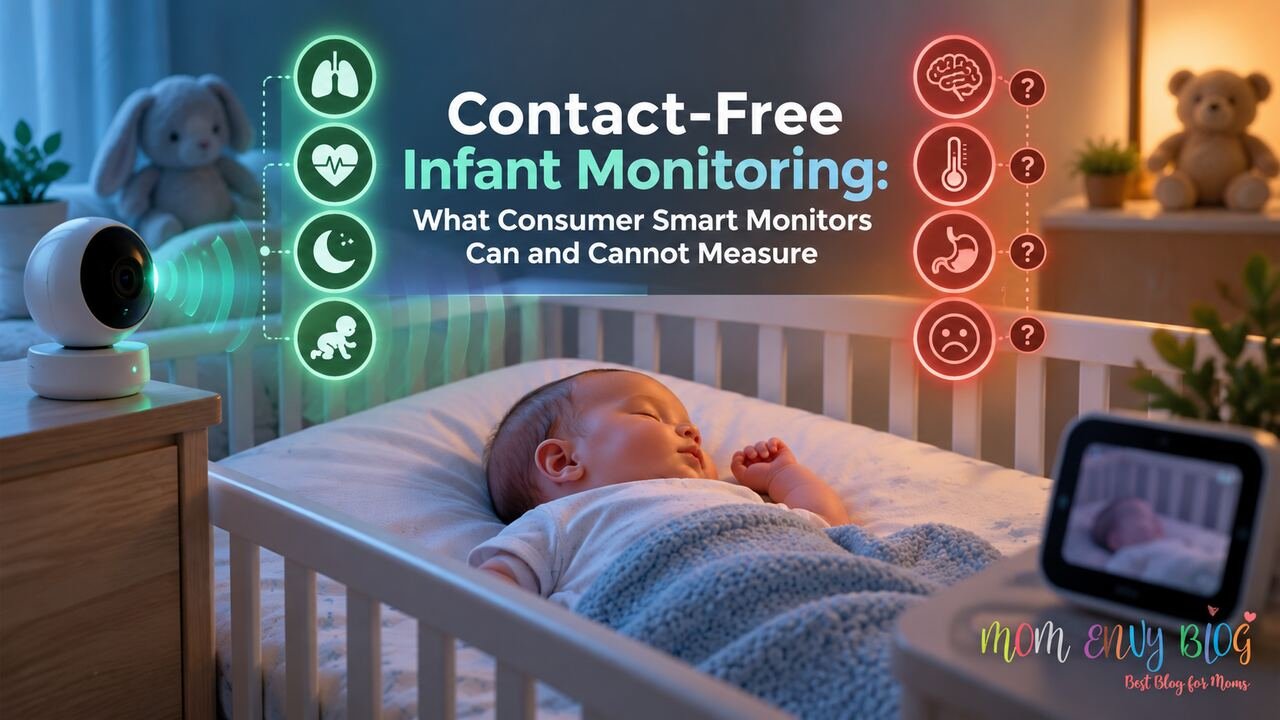
Modern contact-free monitoring relies primarily on two core technological modalities: optical computer vision and radio-frequency sensing. While high-resolution optical cameras utilize algorithmic video analytics to detect movement, advanced short-range millimeter-wave (mmWave) radar technology operates by transmitting low-power radio waves to measure micro-displacements. This radar technology can detect subtle physical chest motion associated with breathing dynamics without touching the infant. By analyzing Doppler phase shifts, non-contact systems can track breathing movement and breathing dynamics while providing sleep-related insights across the night.
Consumer Smart Monitors vs. Medical Devices: Essential Boundaries
As smart nursery monitoring becomes more accessible, establishing clear boundaries between consumer wellness tools and regulated medical devices is critical for safe parenting. Consumer-grade smart monitors are designed strictly for household wellness observation, sleep insights, and parental peace of mind. They are explicitly not medical devices. They cannot diagnose, treat, or cure any medical condition, nor are they intended for monitoring infants with known respiratory distress or for preventing Sudden Infant Death Syndrome (SIDS) or Sudden Unexpected Infant Death (SUID). Standard safe sleep guidelines—such as placing infants on their backs on a firm, flat surface free of loose bedding—remain mandatory regardless of whatever monitoring hardware is installed.
Evaluating Key Performance Variables in Modern Monitors
When selecting a nursery observation system, evaluating technical performance metrics ensures parents choose tools that genuinely simplify caregiving. Having key baby monitor features explained helps clarify how hardware and software work together in real-world environments:
- Optical Clarity & Night Vision: High-definition 2K resolution combined with 940nm invisible infrared LEDs ensures clear video monitoring in pitch darkness without emitting visible red light that could disrupt infant sleep.
- Acoustic & AI Analysis: Intelligent sound recognition algorithms distinguish genuine infant cries from background noise, triggering automated responses like calming lullabies.
- Safety Alerts & Low Latency:Dual-band Wi-Fi (2.4/5GHz) connectivity through the Momcozy App supports timely mobile notifications, such as identifying potential face coverage or changes in sleeping position.
Consumer Application: The Contact-Free Smart Monitor Model
To see these principles in practice, modern consumer solutions illustrate how non-invasive tracking functions in everyday parenting. A prime example is the Momcozy Contact-Free Smart Baby Monitor. Operating as an app-based Wi-Fi smart monitor, it integrates millimeter-wave radar technology to track breathing dynamics and sleep patterns without requiring straps, socks, or wearables. Its AI-driven vision system analyzes sleeper positioning to detect covered faces or unfavorable postures, sending notifications only when necessary to reduce false alert fatigue. Combined with zero ongoing subscription fees and high-definition video, it serves as a representative consumer model balancing non-invasive tracking with practical home utility.
Integrating Smart Monitoring into Safe Sleep Hygiene
Ultimately, consumer technology is designed to complement—not replace—attentive parental supervision and safe sleep hygiene. A contact-free device provides a passive layer of observation that keeps parents informed while allowing infants to sleep completely undisturbed. When parents evaluate options to select the best smart baby monitor for their nursery, understanding both the technological capabilities and explicit medical boundaries empowers families to build a safe, reassuring, and balanced sleep environment.