








Quick Highlights
- At 11 weeks pregnant, your baby is now in the fetal stage and is developing more recognizable facial features, fingers, toes, bones, and internal organs.
- Your baby is moving inside the uterus, although you will not be able to feel those movements yet.
- Nausea, bloating, heartburn, headaches, sore breasts, dizziness, food aversions, mild cramping, and tiredness can still be common.
- Some women notice symptoms beginning to ease as the first trimester progresses, while others continue feeling unwell for several more weeks.
- Your dating scan or first-trimester screening may happen around this stage, depending on your healthcare system.
- Seek prompt medical care for heavy bleeding, severe or one-sided pain, shoulder pain, dizziness, weakness, or fainting.
At 11 weeks pregnant, your baby is now a fetus and is growing quickly. The face, hands, feet, fingers, toes, bones, brain, and internal organs continue developing, while tiny movements are becoming more coordinated. You may still be dealing with nausea, fatigue, sore breasts, heartburn, bloating, headaches, mild cramping, or food aversions.
In my experience, week 11 can bring a little more hope that the hardest first-trimester symptoms may soon ease. But there is no schedule your body has to follow. One mom may feel much better this week while another still needs crackers beside the bed and an afternoon nap.
11 Weeks Pregnant at a Glance
| Pregnancy milestone | What is happening |
| Gestational age | 11 weeks |
| Time since conception | About 9 weeks |
| Developmental stage | Fetus |
| Approximate length | Around 4 cm, although measurements vary |
| Common size comparison | Fig or small lime |
| Major development | Face, fingers, toes, bones, organs, and movement |
| Pregnancy bump | May be starting to appear, but often still subtle |
| Ultrasound | Baby and cardiac activity are usually clearly visible |
| Movement | Baby moves, but you cannot feel it yet |
| Trimester | First trimester |
| Time until estimated due date | About 29 weeks |
MedlinePlus notes that during weeks 11 to 14, the eyelids become more developed, the outer ears take shape, facial features become more distinct, and the intestines rotate into position.
What Happens at 11 Weeks Pregnant?
Week 11 is a period of rapid growth and refinement.
The basic structures of the major organs have already formed, and now those organs continue developing and becoming more functional.
Your baby’s:
- Head and face become more defined.
- Fingers and toes continue separating.
- Bones begin hardening.
- Kidneys are beginning to produce urine.
- Digestive system continues developing.
- External ears become more recognizable.
- Eyelids continue forming.
- Arms and legs can move.
- Nervous system becomes increasingly complex.
At the same time, your uterus is expanding and pregnancy hormones continue affecting your digestion, breasts, circulation, emotions, and energy levels.
Is Your Baby an Embryo or Fetus at 11 Weeks?

At 11 weeks pregnant, your baby is considered a fetus.
MedlinePlus notes that by the end of the 10th week of pregnancy, the developing baby is no longer called an embryo and enters the fetal stage.
The embryonic stage focuses heavily on creating the basic structures of the body. During the fetal stage, those structures continue growing, developing, and becoming more specialized. I hope you haven’t missed our 10 Week Pregnant Guide, where you can learn more about your baby’s development, the changes happening in your body, and what you can expect during this exciting stage of pregnancy.
This does not mean development slows down. Quite the opposite. Your baby will change dramatically over the coming months.
Baby Development at 11 Weeks Pregnant
The face is becoming more recognizable
Your baby’s facial features continue moving into more familiar positions.
Development includes the:
- Eyes
- Eyelids
- Nose
- Mouth
- Jaw
- Chin
- Outer ears
MedlinePlus notes that the outer ears begin taking shape and facial features become more distinct during weeks 11 to 14.
Eyelids are developing
The eyelids continue forming and begin closing over the developing eyes.
They will remain closed for a large part of pregnancy while the eyes continue maturing.
Fingers and toes are more defined
The fingers and toes are separating and becoming more distinct.
Tiny nails will also continue developing during the coming weeks.
Bones are beginning to harden
Much of your baby’s skeleton began as flexible cartilage.
That tissue is gradually beginning the process of turning into harder bone.
The process continues throughout pregnancy and long after birth.
Your baby is moving
Your baby can make small movements with the arms, legs, and body.
You will not feel them yet because your baby is still tiny and the movements are gentle.
If you have an ultrasound, however, you may be able to see some movement on the screen.
I still remember how surprising it was to see those tiny movements before I could feel anything myself. It makes the pregnancy suddenly seem much more real.
The kidneys are beginning to work
The developing kidneys begin producing urine during this stage of pregnancy. MedlinePlus places the beginning of fetal urine production around 9 to 12 weeks.
The kidneys and urinary system will continue maturing throughout pregnancy.
The digestive system continues developing
Your baby’s digestive tract is developing rapidly.
The intestines are growing and beginning to rotate into their normal position.
Other digestive organs, including the liver and pancreas, also continue developing.
The brain and nervous system are growing rapidly
Your baby’s brain remains one of the fastest-growing areas of the body.
Nerve cells are multiplying and beginning to form increasingly complex connections.
The head still looks large compared with the rest of the body because brain development is happening so quickly.
How Big Is Your Baby at 11 Weeks Pregnant?
Your baby is approximately 4 centimeters long from head to bottom, although exact measurements vary.
That is roughly comparable to:
- A fig
- A small lime
- A large strawberry
These comparisons are simply visual aids.
Healthcare professionals use measurements such as crown-to-rump length during first-trimester ultrasound to assess gestational age and early growth.
What Does an 11 Weeks Pregnant Belly Look Like?

You might begin noticing a small bump at 11 weeks, but many women still do not look obviously pregnant.
Your uterus is growing and starting to move higher in the pelvis.
Your stomach may appear fuller because of:
- Uterine growth
- Bloating
- Constipation
- Gas
- Fluid retention
- Previous pregnancies
- Natural body shape
If this is not your first pregnancy, you may start showing earlier because your abdominal muscles and uterus have stretched before.
Do not compare your bump with pregnancy photos online. There is a huge range of normal at this stage.
11 Weeks Pregnant Symptoms
The NHS lists possible symptoms at 11 weeks including aches around the abdomen, nausea, mood swings, metallic taste, sore breasts, indigestion, heartburn, headaches, dizziness, food preferences, smell sensitivity, milky discharge, spotting, and period-like cramping.
Nausea
Morning sickness may still be strong at week 11.
Some women notice improvement, while others continue dealing with nausea for several more weeks.
You may feel sick:
- When you wake
- When your stomach is empty
- Around strong smells
- After eating
- In the evening
- Throughout the day
Try:
- Eating small meals every few hours.
- Keeping a snack beside your bed.
- Avoiding an empty stomach.
- Choosing cooler foods when smells are difficult.
- Sipping fluids regularly.
- Resting when tired.
Ask your healthcare provider for treatment if nausea or vomiting makes it difficult to eat, drink, work, or care for yourself.
Extreme tiredness
Fatigue may still be significant.
Your body is supporting rapid fetal and placental development, and hormonal changes remain strong.
Helpful strategies include:
- Going to bed earlier
- Resting when possible
- Eating regularly
- Drinking enough water
- Delegating household tasks
- Reducing unnecessary commitments
If you already have children at home, perfect rest probably is not realistic. Even simplifying dinner or skipping one nonessential chore can make the day easier.
Sore or fuller breasts
Your breasts may continue feeling:
- Tender
- Heavy
- Tingly
- Swollen
- Sensitive
Your nipples and areolas may also become darker.
A comfortable, supportive bra may help.
Bloating and gas
Progesterone can slow your digestive system.
This may lead to:
- Gas
- Burping
- Fullness
- Abdominal pressure
- Constipation
Smaller meals, gentle movement, adequate fluids, and slower eating may help.
Constipation
Constipation is common during pregnancy.
Try:
- Drinking plenty of water.
- Eating fruit and vegetables.
- Choosing whole grains.
- Adding beans and lentils.
- Staying physically active.
- Increasing fiber gradually.
Ask your healthcare provider before using laxatives or herbal remedies.
Heartburn and indigestion
Hormonal changes may relax the valve between your stomach and esophagus, making heartburn easier to trigger.
You might notice:
- Burning behind the breastbone
- Acid taste in the mouth
- Burping
- Fullness after meals
- Discomfort when lying down
Try:
- Smaller meals
- Staying upright after eating
- Avoiding your personal trigger foods
- Avoiding very large evening meals
Ask your healthcare provider which medications are safe if lifestyle changes do not help.
Headaches
Headaches can result from:
- Hormonal changes
- Dehydration
- Hunger
- Stress
- Fatigue
- Poor sleep
- Reducing caffeine
Rest, regular meals, and adequate fluids may help.
Ask a healthcare professional which pain medicines are appropriate during pregnancy.
Seek urgent care for a sudden severe headache, fainting, weakness, confusion, or vision changes.
Dizziness
Feeling lightheaded can happen because pregnancy affects your circulation and blood pressure.
Try:
- Standing up slowly
- Eating regularly
- Drinking enough water
- Avoiding overheating
- Sitting or lying down if you feel faint
Seek medical care if dizziness is severe, persistent, or associated with bleeding, chest pain, shortness of breath, or fainting.
Food aversions
Strong food dislikes may continue.
Common triggers include:
- Meat
- Eggs
- Coffee
- Garlic
- Fried foods
- Hot meals
- Strong spices
Try another source of the same nutrients instead of forcing yourself to eat something that makes you nauseated.
Food cravings
You may develop strong cravings for certain foods.
Pregnancy cravings do not reliably predict the baby’s sex.
Tell your healthcare provider if you crave nonfood substances such as:
- Soil
- Clay
- Chalk
- Paper
- Laundry starch
- Large amounts of ice
Strong sense of smell
Smell sensitivity may remain strong.
Triggers often include:
- Perfume
- Coffee
- Smoke
- Cooking meat
- Cleaning products
- Pet food
- Refrigerators
Opening windows, eating cold meals, or asking someone else to cook can help.
Metallic taste
A metallic taste may still be noticeable.
You might try:
- Cold water
- Sugar-free gum
- Gentle tongue brushing
- Plastic utensils
- Tart foods if they do not worsen heartburn
Increased vaginal discharge
White or milky discharge without a strong odor can be normal during pregnancy. The NHS includes milky white discharge among possible symptoms at 11 weeks.
Contact your healthcare provider if discharge is:
- Green or gray
- Strongly yellow
- Foul-smelling
- Itchy
- Painful
- Accompanied by burning
Mild cramping
Mild period-like cramping can still occur at 11 weeks.
Possible causes include:
- Uterine growth
- Digestive changes
- Gas
- Constipation
- Increased pelvic blood flow
Seek medical advice if pain is severe, worsening, persistent, or mainly on one side.
Light spotting
The NHS lists light spotting among possible symptoms at 11 weeks but recommends seeking medical advice for bleeding during pregnancy.
Bleeding does not always mean miscarriage, but it should not be ignored.
Seek prompt care for:
- Heavy bleeding
- Severe cramps
- Significant abdominal pain
- Dizziness
- Fainting
- Shoulder pain
Is It Normal to Have No Symptoms at 11 Weeks Pregnant?
Yes.
Some women notice strong symptoms at 11 weeks, while others begin feeling much better.
You may suddenly notice:
- Less nausea
- More energy
- Less breast tenderness
- Better appetite
- Less smell sensitivity
This can be completely normal as your body adapts and pregnancy hormones begin changing.
Symptoms are not a reliable way to determine whether your baby is developing normally.
Contact your healthcare provider if you have concerns, especially when changes occur alongside bleeding or significant pain.
Why Are My Pregnancy Symptoms Getting Better at 11 Weeks?
For some women, symptoms begin easing as the first trimester progresses.
The placenta is becoming increasingly established, and your body may be adjusting to pregnancy hormone levels.
The NHS notes that by week 12 there is a good chance the placenta is taking over more of the work of supporting the baby, and hormone-related sickness may begin settling.
You might notice:
- Less nausea
- More appetite
- More energy
- Less dizziness
- Less breast soreness
Other moms will not feel better until several weeks later.
Both patterns can happen.
Can You See the Baby on an Ultrasound at 11 Weeks?
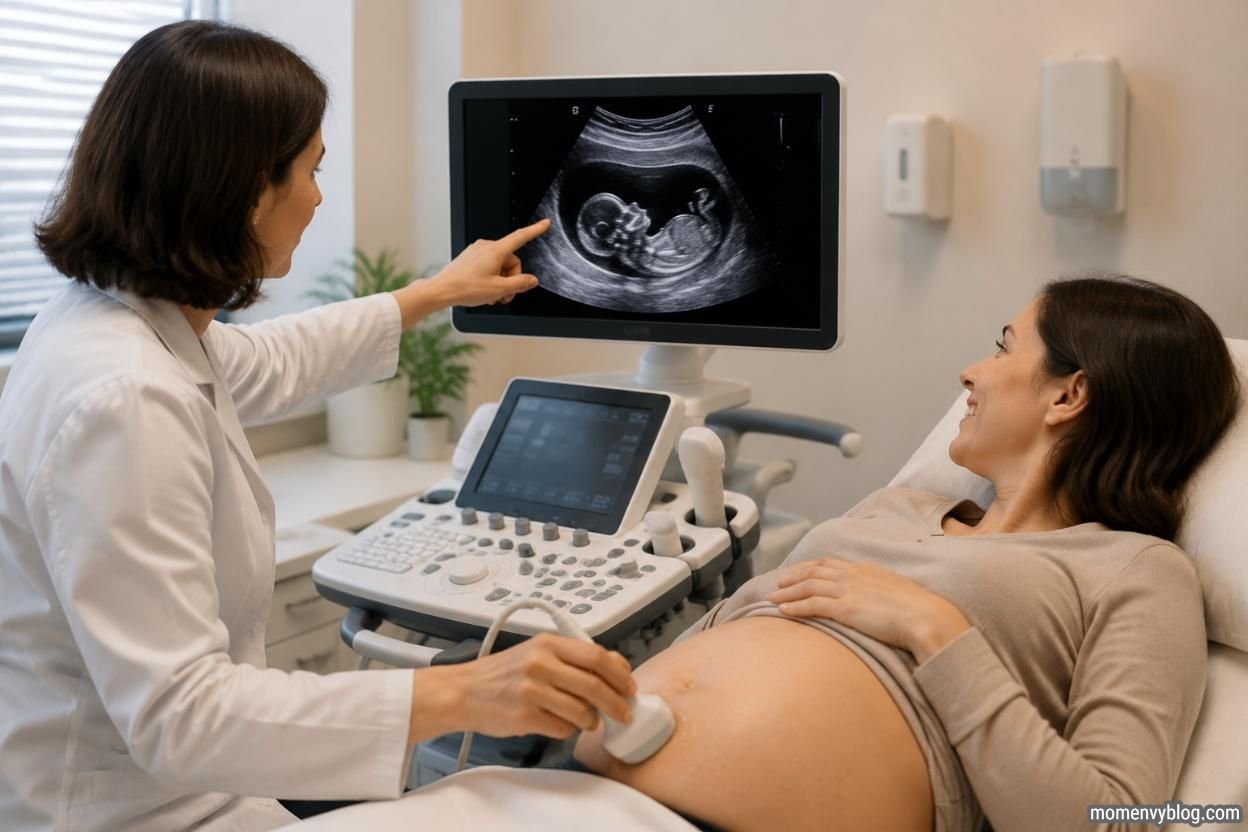
Yes.
At 11 weeks, an ultrasound can usually show:
- The head
- The body
- Arms and legs
- Cardiac activity
- Small movements
- Crown-to-rump length
- The pregnancy’s location
- Whether more than one baby is present
The baby may stretch, wiggle, or move during the scan even though you cannot feel those movements.
What Does an 11-Week Ultrasound Look Like?
Your baby is beginning to look much more recognizable.
You may be able to distinguish:
- A large head
- A curved body
- Arms
- Legs
- Hands and feet
- Small movements
The image will still lack the detail you will see at later scans, but there is usually a big difference compared with an ultrasound performed at 6 or 7 weeks.
Can You Hear the Heartbeat at 11 Weeks?
Cardiac activity can usually be seen on ultrasound at 11 weeks.
A healthcare professional may sometimes be able to detect fetal heart tones with a Doppler around this stage. MedlinePlus notes that fetal heart tones may become detectable by Doppler during weeks 11 to 14.
However, not hearing it with a Doppler at exactly 11 weeks does not necessarily mean something is wrong.
Detection depends on:
- Baby’s position
- Uterine position
- Placental location
- Your body anatomy
- Equipment
- Exact pregnancy dating
Home Dopplers can create unnecessary anxiety and should not replace prenatal assessment.
Can You Feel the Baby Move at 11 Weeks?
No, you normally cannot feel the baby moving yet.
Your baby may already wiggle, stretch, and move the limbs, but the movements are too small for you to notice.
Most moms first recognize fetal movement later in pregnancy.
If this is your second or third pregnancy, you may recognize movement a little earlier than you did the first time, but 11 weeks is still generally too soon.
First-Trimester Screening at 11 Weeks
This is an important time to discuss prenatal screening because some first-trimester tests are performed within specific time windows.
Depending on your healthcare system, medical history, and preferences, screening may include:
- Blood tests
- Noninvasive prenatal testing
- Nuchal translucency ultrasound
- Carrier screening
- Screening for infections
- Blood group and Rh factor testing
Screening tests estimate the chance of certain conditions. They do not provide the same certainty as diagnostic tests.
Your doctor or midwife can explain:
- What each test screens for
- When it should be performed
- Its accuracy
- What a positive result means
- Whether additional testing would be offered
What Is a Nuchal Translucency Scan?
A nuchal translucency scan measures fluid at the back of the baby’s neck.
It is performed during a specific stage of the first trimester and may be combined with blood testing to estimate the chance of certain chromosomal conditions.
The scan also gives healthcare professionals another opportunity to assess:
- Gestational age
- Cardiac activity
- Early anatomy
- Number of babies
It is a screening test, not a diagnosis.
What Is NIPT?
Noninvasive prenatal testing, often called NIPT or cell-free DNA screening, uses a maternal blood sample to screen for an increased chance of certain chromosome conditions.
It analyzes small fragments of placental DNA circulating in your blood.
NIPT is a screening test. A high-risk result generally requires discussion and potentially diagnostic testing before conclusions are made.
Availability, recommended timing, and coverage vary depending on where you live.
What Should You Do at 11 Weeks Pregnant?
1. Continue your prenatal vitamin
Continue taking the prenatal vitamin recommended by your healthcare provider.
Folic acid remains especially important during early pregnancy.
Follow the dose your clinician recommends, particularly if you have a health condition or take medicines that affect folate requirements.
2. Attend prenatal appointments
If you have not already had your first visit, arrange prenatal care.
Bring questions about:
- Symptoms
- Medications
- Prenatal screening
- Ultrasound
- Nutrition
- Exercise
- Travel
- Vaccinations
- Mental health
- Previous pregnancy concerns
3. Discuss prenatal screening
Some first-trimester screening options have specific timing windows.
Ask your healthcare provider what is available and whether you need to make decisions soon.
4. Review medicines and supplements
Tell your healthcare provider about everything you take, including:
- Prescription medicines
- Pain relievers
- Cold medicines
- Herbal remedies
- Supplements
- Skin products
- Sleep aids
- Vitamins
Do not stop prescribed medication suddenly unless your healthcare professional tells you to.
5. Eat what you can tolerate
If nausea remains strong, focus on small, manageable meals.
Helpful foods may include:
- Toast
- Rice
- Potatoes
- Oatmeal
- Yogurt
- Eggs
- Soup
- Fruit
- Nut butter
- Mild protein foods
As your appetite improves, gradually work back toward a varied diet.
6. Stay hydrated
Drink throughout the day.
Small amounts frequently may be easier if you are nauseated.
Try:
- Cold water
- Ice chips
- Diluted juice
- Soup
- Water-rich fruit
Call your healthcare provider if you cannot keep fluids down.
7. Continue suitable exercise
Most women with uncomplicated pregnancies can continue moderate activity.
Options may include:
- Walking
- Swimming
- Stationary cycling
- Gentle strength training
- Prenatal yoga
- Low-impact exercise
Ask your healthcare provider about personal restrictions.
8. Rest when your body asks
You may start getting more energy soon, but there is no need to push yourself.
Use the energy you have wisely rather than assuming you should suddenly return to your pre-pregnancy pace.
9. Take care of your teeth and gums
Pregnancy hormones can make gums more sensitive and prone to bleeding.
Continue:
- Brushing twice daily
- Flossing
- Regular dental care
- Telling your dentist that you are pregnant
Dental treatment should not automatically be postponed simply because you are pregnant. Your dentist and prenatal provider can guide you about specific procedures.
What Should You Avoid at 11 Weeks Pregnant?

Avoid or carefully manage:
- Alcohol
- Smoking and vaping
- Recreational drugs
- Unreviewed medicines
- High-dose supplements unless prescribed
- Foods considered unsafe during pregnancy
- Fish high in mercury
- Excessive caffeine
- Harmful chemical exposures
- Activities that cause overheating
- Crash dieting
Normal daily movement, walking, stairs, bending, sex, and routine household activities do not generally cause miscarriage in an uncomplicated pregnancy.
Can Sex Cause Miscarriage at 11 Weeks?
Sex does not normally cause miscarriage in a healthy, uncomplicated pregnancy.
Your baby is protected within the uterus.
You may occasionally notice mild cramping or light spotting after sex because the cervix can be more sensitive during pregnancy.
Contact your healthcare provider if you develop:
- Heavy bleeding
- Severe pain
- Persistent cramps
- Fluid leakage
- Symptoms that worry you
Follow any specific restrictions your healthcare provider has given you.
Is Cramping Normal at 11 Weeks Pregnant?
Mild cramping can still occur.
The NHS includes period-like cramping among possible symptoms at 11 weeks.
It may feel like:
- Light menstrual cramps
- Pulling
- Stretching
- Brief twinges
- Mild pelvic pressure
Gas and constipation can also cause discomfort.
Seek medical advice if the pain is severe, persistent, getting worse, or concentrated on one side.
Is Bleeding Normal at 11 Weeks Pregnant?

Light spotting can occur, but bleeding should be discussed with a healthcare professional.
Early pregnancy bleeding can have several causes and does not automatically mean miscarriage.
Seek prompt medical attention for:
- Heavy bleeding
- Increasing cramps
- Severe abdominal pain
- One-sided pain
- Shoulder pain
- Dizziness
- Weakness
- Fainting
What Are the Signs of Miscarriage at 11 Weeks?
Possible signs of early pregnancy loss include:
- Vaginal bleeding
- Increasing abdominal cramps
- Lower-back pain
- Passing fluid
- Passing clots or tissue
Symptoms alone cannot always tell whether a miscarriage has occurred.
Some women experience bleeding and continue to have healthy pregnancies.
A healthcare professional may use:
- Ultrasound
- Examination
- Blood testing
- Follow-up assessment
to determine what is happening.
Ectopic Pregnancy Warning Signs

An ectopic pregnancy occurs when a fertilized egg implants outside the main cavity of the uterus, usually in a fallopian tube.
Warning signs can include:
- One-sided pelvic or abdominal pain
- Vaginal bleeding
- Shoulder pain
- Dizziness
- Weakness
- Fainting
These symptoms require urgent medical assessment because ectopic pregnancy can become life-threatening.
Can You Be 11 Weeks Pregnant With Twins?
Yes. A twin pregnancy should usually be identifiable on ultrasound by this stage.
The scan may help determine:
- The number of babies
- Cardiac activity
- Whether they share a placenta
- Whether they share an amniotic sac
- Early growth measurements
Strong pregnancy symptoms alone cannot confirm twins.
How Many Months Is 11 Weeks Pregnant?
At 11 weeks, you are generally considered to be in your third month of pregnancy and still in the first trimester.
You have about one to two weeks left before reaching the end of the first trimester, depending on the definition being used.
Healthcare professionals usually prefer weeks and days because they are more precise than pregnancy months.
Your 11 Weeks Pregnant Checklist

Continue taking your prenatal vitamin.
Attend your prenatal appointments.
Review medications and supplements.
Discuss first-trimester screening.
Ask about NIPT if you are interested.
Check when your dating or nuchal translucency scan is scheduled.
Follow pregnancy food-safety guidance.
Eat small meals if nausea continues.
Stay hydrated.
Monitor caffeine intake.
Continue suitable physical activity.
Keep up with dental care.
Rest when you need it.
Seek help if vomiting becomes severe.
Know which bleeding or pain symptoms require medical attention.
Read the 12 Weeks Pregnant guide next.
What Happens at 12 Weeks Pregnant?
At 12 weeks, you are approaching the end of the first trimester.
The placenta is increasingly taking over the job of supporting the pregnancy, and some women notice nausea and fatigue beginning to improve. The baby is about 5.4 cm long from head to bottom, the internal organs and muscles have grown, the skeleton is beginning to harden into bone, and cardiac activity can be seen on ultrasound.
During the next week:
- The baby grows rapidly.
- The face becomes more defined.
- Fingers and toes are clearly separated.
- Bones continue hardening.
- Internal organs continue maturing.
- The placenta takes on more work.
- First-trimester screening may occur.
- Your appetite may begin returning.
Next article: 12 Weeks Pregnant: Symptoms, Baby Development, and What to Expect
FAQ’s
What is happening at 11 weeks pregnant?
Your baby is now in the fetal stage. Facial features, ears, eyelids, fingers, toes, bones, kidneys, brain, digestive system, and other organs continue developing.
What symptoms are common at 11 weeks pregnant?
Symptoms may include nausea, abdominal aches, mood swings, metallic taste, sore breasts, heartburn, headaches, dizziness, food aversions, smell sensitivity, discharge, spotting, and mild cramping.
Is it normal to have no symptoms at 11 weeks?
Yes. Symptoms may begin easing as you approach the end of the first trimester. A decrease in symptoms does not automatically mean something is wrong.
Are pregnancy symptoms supposed to improve at 11 weeks?
They may. Some women start feeling better around this time, while others continue having nausea and fatigue for several more weeks.
How big is the baby at 11 weeks?
Your baby is approximately 4 cm long from head to bottom, although exact measurements vary.
Is my baby an embryo or fetus at 11 weeks?
Your baby is considered a fetus at 11 weeks. MedlinePlus notes that the fetal stage begins after the 10th week of pregnancy.
Can the baby move at 11 weeks?
Yes. Your baby can make small movements, although you cannot normally feel them yet.
Can you feel the baby move at 11 weeks?
Usually not. The baby is still too small for its movements to be noticeable.
Can you see the baby on an ultrasound at 11 weeks?
Yes. The head, body, arms, legs, cardiac activity, and movements are usually visible.
Can you hear the heartbeat at 11 weeks?
Fetal heart tones may become detectable by Doppler during weeks 11 to 14, but not hearing them at exactly 11 weeks does not necessarily indicate a problem.
Is cramping normal at 11 weeks?
Mild period-like cramping can occur. Severe, persistent, worsening, or one-sided pain should be assessed by a healthcare professional.
Is spotting normal at 11 weeks?
Light spotting can occur, but discuss any pregnancy bleeding with your healthcare provider.
Can I have a baby bump at 11 weeks?
You may begin noticing a small bump or thicker waist, particularly if you have been pregnant before. Many women still do not visibly show.
Why am I still so bloated at 11 weeks?
Pregnancy hormones can slow digestion, causing gas, constipation, and bloating.
Should I have prenatal screening at 11 weeks?
Some first-trimester screening tests are performed around this stage. Ask your healthcare provider about the tests available to you and their timing.
Can I have NIPT at 11 weeks?
NIPT is often available around this stage, although exact timing and availability depend on your healthcare system.
Can symptoms disappear at 11 weeks?
Yes. Symptoms may naturally become milder as you approach the second trimester.
Can sex cause miscarriage at 11 weeks?
Sex does not normally cause miscarriage in an uncomplicated pregnancy.
How many months is 11 weeks pregnant?
Eleven weeks pregnant is generally part of the third month and first trimester.
The Bottom Line
At 11 weeks pregnant, your baby is now a fetus and continues developing rapidly. The face, eyelids, ears, fingers, toes, kidneys, digestive system, brain, bones, and other organs are becoming more mature, and your baby is already making movements you cannot yet feel.
You may still have nausea, bloating, heartburn, headaches, sore breasts, dizziness, mild cramping, or food aversions. You may also notice symptoms beginning to ease as you move closer to the second trimester.
Continue your prenatal care, review your screening options, take your prenatal vitamin, eat what you can tolerate, stay hydrated, and listen to your body. Seek prompt medical care for heavy bleeding, severe or one-sided pain, shoulder pain, dizziness, weakness, or fainting.
Medical note: This article provides general educational information and is not a substitute for personalized medical advice, diagnosis, or treatment from a qualified healthcare professional.


